
REVIEW · CANOPY TOURS
Seward: Stoney Creek Canopy Tour with Zipline
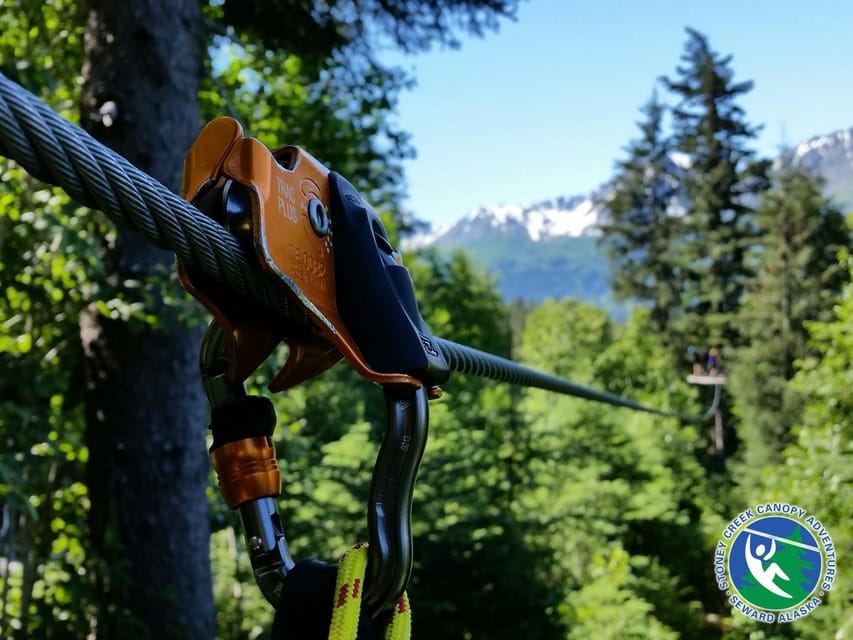
Stoney Creek Canopy Adventures gives you an unusual way to see Seward: not from a boat, trail, or roadside lookout, but from a series of platforms high in the old-growth Pacific forest. You’ll cross eight ziplines, three suspension bridges, and two rappels while the Stoney Creek valley opens below you.
I like the variety of the course, which starts with a short beginner-friendly line and builds toward a 1,100-foot ride over a reflecting pond. I also like the small groups, limited to eight people, and the careful practice session before the real course begins. The main drawback is simple: this is not a good choice if you dislike heights, cannot lift both arms fully overhead, or prefer a quiet forest walk to an active adventure.
Key points at a glance
- Eight ziplines with changing views: The course moves from low forest lines to long rides high across the valley wall.
- A 1,100-foot highlight: One of the longest traverses crosses above the trees, a reflecting pond, and the mountains beyond.
- Three suspension bridges and two rappels: You do more than zip, with climbing-style sections woven into the route.
- A small group of up to eight: Guides can keep the instruction personal and the pace moving.
- A strong guide team: The staff lead the safety briefing, practice runs, equipment fitting, and every transition.
- A rain-or-shine outing: Bring suitable clothing and closed-toe shoes, since weather does not cancel the experience automatically.
From Seward Harbor to the Stoney Creek Valley
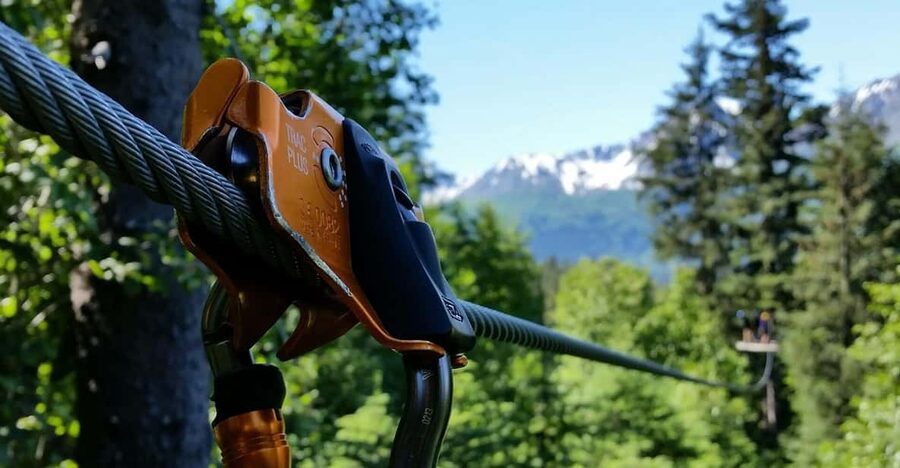
Your outing begins at the Adventure Center in the Seward Small Boat Harbor. From there, a Stoney Creek Canopy Adventures van takes you out to the course. The ride is included, so you do not need to arrange your own transportation.
Pay close attention to timing. The office asks you to check in 45 minutes before your tour time, while the van leaves 30 minutes before the scheduled start. That means arriving early is the sensible plan. Missing the van could be far more troublesome than arriving with time to spare.
At the course, the first thing you see is a large yurt built in a tree above the ground. This is the Welcome Center, and it serves as the base before and after your time on the lines. You can leave belongings there, but the restrictions are strict: backpacks, bags, food, drinks, headphones, selfie sticks, gum, alcohol, and drugs are not allowed on the activity.
You may bring a phone or camera, but you need a way to secure it to yourself. A loose phone is a safety problem on a zipline, and there is no point bringing a camera you cannot use safely. Water is included, but other food and drinks are not permitted.
More Canopy Tours in the USA
- Big Island Kohala Canopy Zipline Adventure
★ 5.0 · 720 reviews - Ketchikan Shore Excursion: Rainforest Canopy Ropes and Zipline Adventure Park
★ 5.0 · 390 reviews - Minnesota River Valley 14-Line Thrilling Zipline Canopy Tour
★ 5.0 · 304 reviews
Ground school before the first zipline
At the Welcome Center, your group meets the guides and receives helmets and harnesses. The guides explain how to ride and, just as important, how to brake. You then complete practice runs close to the ground.
This part may feel less exciting than the first high platform, but it is one of the most useful sections of the experience. You learn the body position, hand placement, and braking technique before the valley views and height enter the picture. If you are nervous, this is the time to ask questions and get comfortable with the equipment.
The guide staff receive especially strong praise for their work. That makes sense here, because the course involves several different skills, not just sitting in a harness and moving from point to point. You need clear directions for the lines, bridges, walking sections, and rappels. A good guide keeps the group calm and organized.
The group size is capped at eight people. That is a useful limit for a course with repeated launches and landings. It should mean less waiting than on a large-group attraction, though each person still needs time to be checked and guided through the activities.
The upper valley and the first three lines
After the practice session, the group rides up a forest road to a launch point near the top of the valley. From there, a short walk brings you to the course entrance and the first zipline.
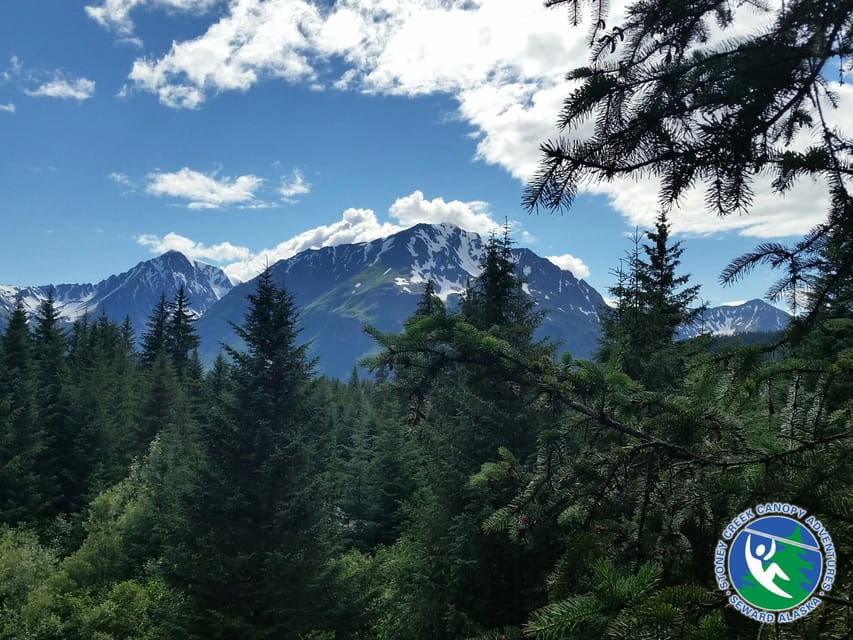
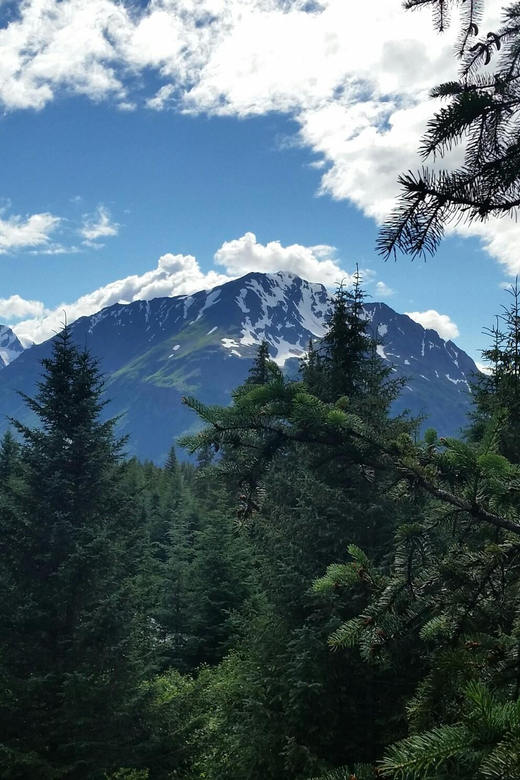
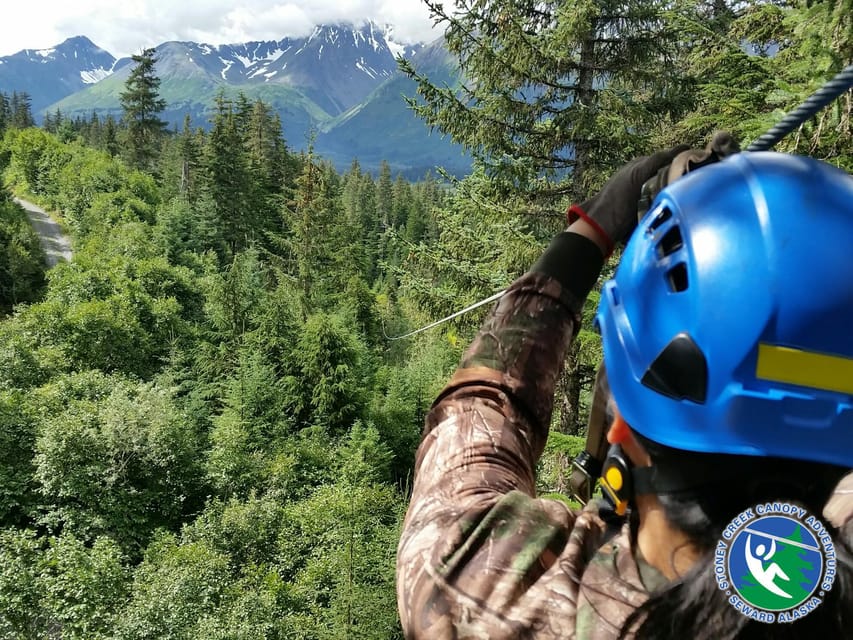
The opening platform has a panoramic view toward the valley and glaciers to the southwest. This early viewpoint gives you a sense of the setting before the route turns farther into the forest. The scenery is not an extra decoration here. It is part of the reason to choose this course over an indoor or lower-level zipline experience.
The first line is only 65 feet long and runs fairly close to the ground across the fall line. That short length is useful. You can concentrate on your position and braking instead of trying to take in every view at once.
The course then becomes more dramatic. The third zipline travels 190 feet and ends about 50 feet up the trunk of a large Sitka spruce. You are now moving between elevated platforms rather than staying near the forest floor. The Sitka spruce trees give the course a distinct Alaska feel, with the route built into living forest rather than placed on a simple open tower.
The exact sequence has enough variation to keep the early section from feeling repetitive. Some lines are short and instructional, while others give you more time in the air. That variety was one of the most praised parts of the experience, and it is easy to see why.
The 1,100-foot ride across the trees
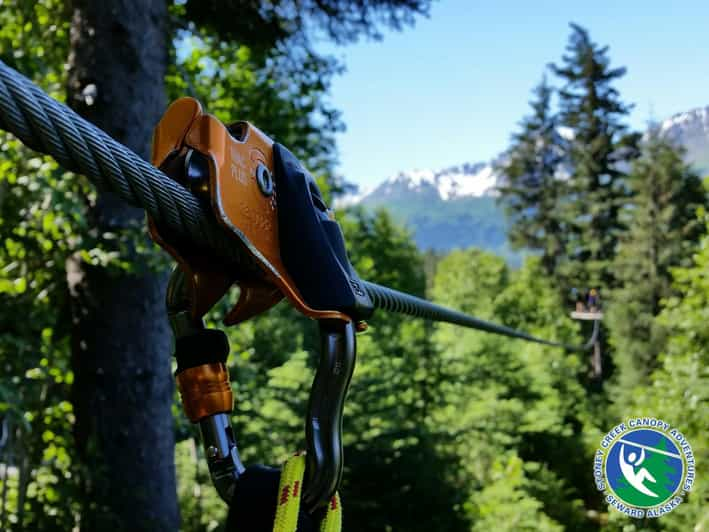
The fifth traverse is the major early highlight. At 1,100 feet, it carries you high above the trees and back across the valley wall. The line passes over a reflecting pond and finishes at a platform about 75 feet up another Sitka spruce.
This is the point where the course shifts from practice and warm-up to a genuine aerial ride. The long length gives you more time to look around, though you still need to pay attention to the guide’s instructions and your arrival at the platform.
The view here combines several parts of Seward’s setting: forest below, the valley stretching across, and glaciers toward the southwest. You are not simply looking at one mountain from a fixed platform. The perspective changes as you move across the valley.
The height can also be the most demanding part for anyone uneasy with exposure. The course is not suited to people afraid of heights, and that warning deserves attention. A short low line may feel manageable, but the long upper traverses give you a very different sensation.
Same trees, a different way down:
- Koloa Zipline in Kauai
★ 5.0 · 6,764 reviews - Oahu’s North Shore: 8-Line Zipline Adventure
★ 5.0 · 3,616 reviews - 7-Line Zipline Experience in Sevierville
★ 5.0 · 2,872 reviews - 7-Line Maui Zipline on the North Shore
★ 4.5 · 1,648 reviews
Into the darker forest and the 600-foot line
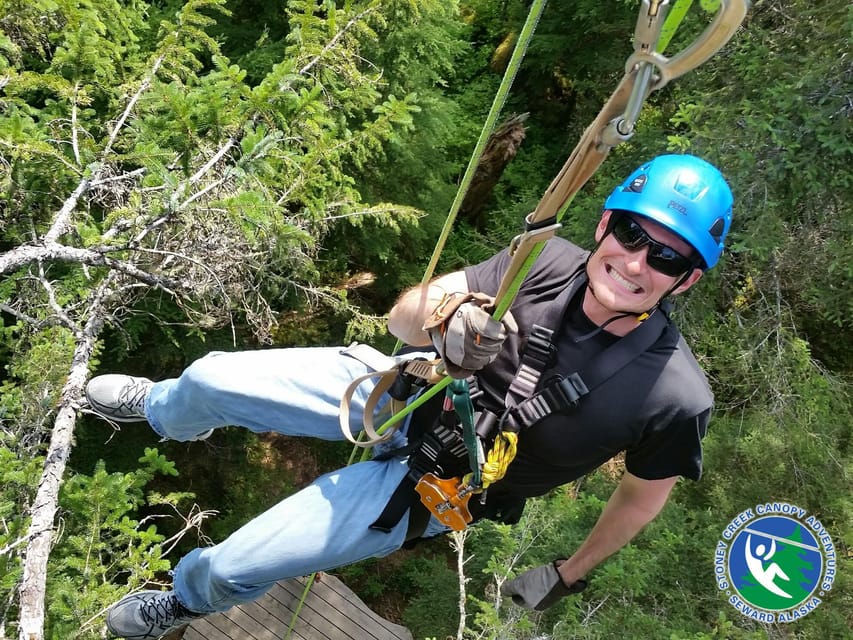
After the upper valley section, the route descends into denser forest. The vegetation becomes thicker, the light grows darker, and sparkling creeks appear among the trees. This change gives the course a second character.
The early lines are about open views and distance. The later section is more about being surrounded by the forest. I like that progression because you get two distinct settings in one outing instead of repeating the same view eight times.
A 600-foot zipline carries you into a large mountain hemlock. It is shorter than the 1,100-foot traverse but still long enough to feel like a proper ride. A shorter mid-level line follows, along with a spot where bald eagles have often been seen.
The eagle sighting is not guaranteed, so treat it as a possibility rather than a promised feature. Even without one, the location adds interest to the stop. The route keeps you alert to the forest around you, not only the next platform.
Rappelling and the aerial walkway
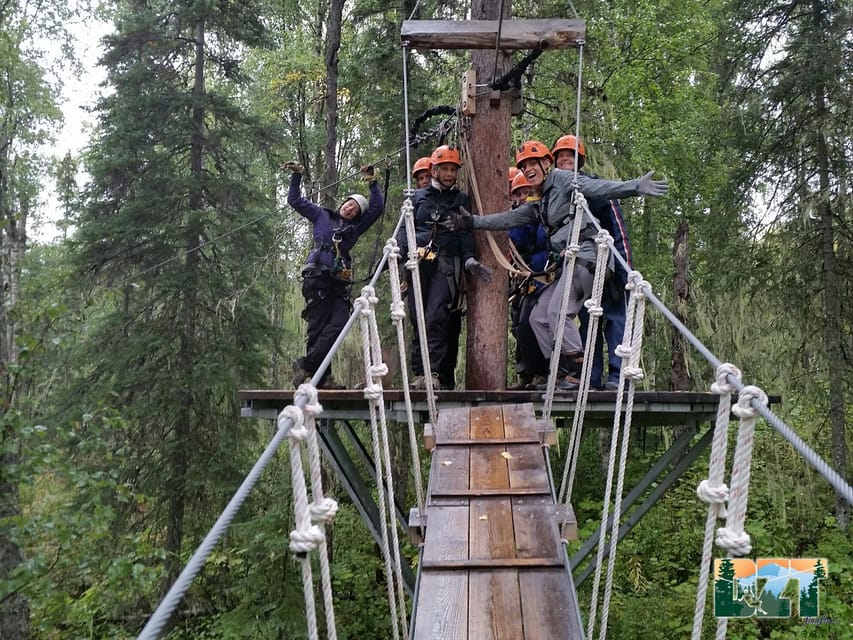
From a landing platform, every group member rappels 60 feet down to the entrance of an aerial walkway. This is a different motion from the ziplines and gives you a chance to control your descent with the equipment and the guide’s instructions.
If you have never rappelled, this may be the moment that requires the most focus. You are no longer traveling horizontally. You are lowering yourself down a vertical section while staying connected to the system. The guides are there to direct the process, but you still need to follow instructions and use your arms properly.
The walkway begins close to the ground and ends 120 feet later at a point 60 feet up another Sitka spruce. That gradual rise makes it more interesting than a simple bridge between two platforms. You move through the forest while gaining height, then turn 90 degrees onto a long bridge.
The course uses this sequence well. A zipline gives you speed, a rappel gives you a controlled descent, and the walkway and bridge slow things down. The mix explains why the course feels more varied than a basic line-to-line setup.
Bridges, lower lines, and the final rappel
After the 90-degree turn, you cross a long bridge to a hemlock where ziplining resumes. The bridge adds a small balance challenge and another way to see the forest from above. It is also one of the spots where you may appreciate having a smaller group, since the crossing can be handled in an orderly way.
A 280-foot line then heads toward the valley floor, ending in a spruce near the entry road. By this stage, the route is descending and the setting feels closer to the forest floor again.
The final traverse crosses over the tour parking area and passes the Welcome Center yurt. It ends in a group of Sitka spruce, where a 40-foot rappel returns you to the ground. The course closes the loop in a practical way, bringing you back near the place where you started.
After removing your helmet and harness, you return to the Welcome Center to collect your belongings. Photos taken during the adventure are available to view and select there. Since cameras and phones must be secured during the activity, these course photos may be your easiest way to come home with action shots.
What the $179 price includes
At $179 per person, this is not a cheap add-on. The value depends on how much you want a full aerial activity rather than a short zipline ride.
The price includes the van pickup and return, guides, water, safety instruction, equipment use, and the complete 2.5-hour course. You are paying for eight lines, three bridges, two rappels, forest access, and the staff required to run each section safely.
The time matters. A shorter zipline attraction might cost less, but it may also offer only one or two lines and limited instruction. Here, the course takes you through several types of activity and several parts of the valley.
I would call it good value for someone who enjoys active outings and wants more than a scenic viewpoint. It is less convincing for a person mainly seeking glacier scenery. In that case, a boat trip or another sightseeing activity may give you more time looking at the mountains for the money.
The small group also helps support the price. A maximum of eight people means the guides are working with a manageable group through multiple transitions. If your party is a family or a small group of friends, the format is especially appealing.
Who should book this Seward canopy tour
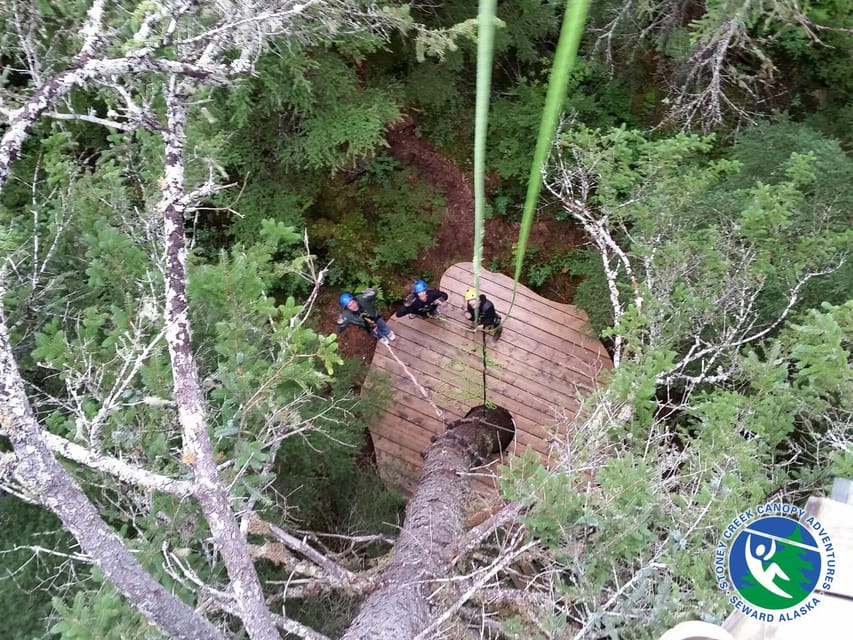
This outing suits active adults, older children, and families with children aged 10 or above who are comfortable with height and physical participation. One available family group included five people ranging from 17 to 50, a useful indication of the broad age range the course can serve.
You need to be able to raise both arms completely above your head. This is required, with no exceptions. The experience is also not suitable for pregnant women, people with back problems, or anyone over 270 pounds or under 88 pounds.
Wear comfortable clothes and closed-toe shoes. Open-toed shoes are not allowed. Since the tour runs rain or shine, consider clothing that can handle wet weather, though the supplied information does not specify a particular waterproof clothing requirement.
You should also be honest with yourself about heights. The course includes platforms as high as 75 feet in Sitka spruce trees, along with long lines across the valley. If you already know that height makes you freeze, this is not the right place to test that theory.
Practical details before you reserve
The activity lasts 2.5 hours, with starting times available by date. English is the tour language. Cancellation is free up to 24 hours before the activity for a full refund, and you can reserve now and pay later.
The tour runs in small groups of no more than eight people. Smoking is not allowed, and neither are alcohol or drugs. Food and drinks other than the included water are also prohibited.
The mention of lanyards deserves a quick note. Lanyards are listed as not included, so do not assume you will receive one for a phone or camera. You are responsible for having a safe way to secure any device you bring.
The biggest planning tip is to allow extra time at the harbor. Check in 45 minutes before the tour, and remember that the van leaves 30 minutes before the scheduled activity time. If you are connecting this with another Seward excursion, leave a generous gap rather than trying to make a tight transfer.
Should you book Stoney Creek Canopy Adventures?
Book it if you want an active Seward experience with real variety: a low practice line, high tree platforms, an 1,100-foot traverse, three bridges, two rappels, and a changing forest setting. The guide team and small groups add practical value, especially if this is your first canopy course.
Skip it if your main goal is a relaxed view of glaciers, or if you have back problems, are pregnant, are outside the weight limits, or dislike heights. At $179, it deserves to be a central activity rather than an impulse purchase.
For the right person, this is one of Seward’s more memorable ways to see the valley. You will work for the views, but the course gives you plenty of different ways to reach them.
FAQ
How long does the Stoney Creek Canopy Tour last?
The tour lasts 2.5 hours.
How many ziplines are included?
The course includes eight ziplines.
How many bridges and rappels are part of the experience?
You cross three suspension bridges and complete two rappels.
Where do I meet for the tour?
You meet at the Adventure Center in the Seward Small Boat Harbor.
Is transportation to the course included?
Yes. A Stoney Creek Canopy Adventures van takes you from the Adventure Center to the course and returns you afterward.
How early should I check in?
You should check in at the office 45 minutes before your tour time. The van leaves 30 minutes before the scheduled tour.
What should I wear?
Wear comfortable clothes and closed-toe shoes. Open-toed shoes are not allowed.
Can I bring my phone or camera?
Yes, but you must have a way to secure it to yourself. Selfie sticks, backpacks, and bags are not allowed.
Is the tour suitable for children?
The tour is not suitable for children under 10 years old.
What are the weight and physical requirements?
Participants must weigh between 88 and 270 pounds, or 40 and 122 kilograms, and must be able to raise both arms completely above their heads. The tour is not suitable for people with back problems or pregnant women.
Newest lines around the USA
- Hakalau: 9-Line Zipline Adventure with Umauma Falls View★ 4.5 · 7 reviews
- Twin Falls: Zip Line Tour★ 4.1 · 8 reviews
- Tree Tops Zip Line Canopy Tour★ 5.0 · 32 reviews
- New River Gorge, WV – Zip Line Tour★ 5.0 · 7 reviews
- Zipline Canopy Tour- ArborTrek at Smugglers Notch Resort★ 5.0 · 9 reviews
- Wildman Zip Line Tour★ 5.0 · 10 reviews
- Zipline and Adventure Tower at Ryze Adventure in Missouri★ 5.0 · 4 reviews
- Zipline the Goliath in The Smoky Mountains★ 5.0 · 5 reviews
Canopy Tours, compared.
Rotorua Canopy Tours: 2.5Hour Native Forest Zipline Adventure
Read our review →
Puerto Vallarta Best Zipline Canopy + Tequila and Speed Boat Ride
Read our review →
Puerto Vallarta’s Best Canopy Zipline + Jorullo Bridge walk!
Read our review →
Storms River: Tsitsikamma National Park Zipline Canopy Tour
Read our review →
Ketchikan Shore Excursion: Rainforest Canopy Ropes and Zipline Adventure Park
Read our review →
Minnesota River Valley 14-Line Thrilling Zipline Canopy Tour
Read our review →Browse the lists this ride appears in